


My dog barks at seemingly empty spaces throughout the day and night. Sometimes I can identify the trigger: a squirrel darting past the window, the mail truck rumbling down the street, or our regular mail carrier whom my dog has declared his sworn enemy. Other times, there appears to be nothing there at all. Just vacant air, blank walls, or empty hallways.
Yet there he stands, fur raised, eyes fixed on some invisible target, growling as if our home is under attack from unseen forces. This behavior naturally led me to wonder: can dogs actually see ghosts?
If mine can detect spirits, we apparently share our space with at least three of them, and one seems particularly fond of the hallway closet.
When Normal Sounds Become Supernatural Encounters
After 9:30 p.m., everyone in our household moves with careful precision. We live in an older home with floors that announce every footstep, and Falkor, our devoted but theatrical Poogle, maintains constant vigilance. The smallest creak reverberates like thunder, and he transforms into a four-legged alarm system within seconds.
This reaction makes perfect sense when there are actual sounds to investigate. The puzzling moments occur when he loses composure over apparent nothingness. No footsteps echo through the house. No delivery trucks rumble outside. No raccoons raid our garbage. Just Falkor, positioned in the hallway, barking at empty space.
This leaves me with two possible explanations: either my dog is experiencing some form of confusion, or we genuinely share our home with spirits.
Historical Beliefs About Dogs and the Supernatural
For thousands of years, people across cultures have believed dogs possess the ability to sense phenomena beyond human perception, particularly regarding paranormal activity. Long before motion detectors and electronic ghost hunting equipment existed, dogs served as the original supernatural detection system.
Even today, many people report their dogs exhibiting strange behavior in historic buildings, cemeteries, or during funeral services. These dogs may whine persistently, pace nervously, or refuse to enter specific rooms entirely.
Throughout history, one pattern has remained consistent: dogs have maintained a reputation for detecting things that escape human awareness. From ancient burial grounds to reportedly haunted structures, dogs consistently appear in locations where supernatural activity is documented.
Cultural Legends and Folklore
Howling as Death Omens In several Eastern European traditions, a dog howling during nighttime hours was interpreted as a signal that death would soon visit the community. Three consecutive howls were considered a specific premonition that someone would die. Some cultures even believed that a dog’s prolonged, intense stare could predict tragedy. Whether these beliefs stem from superstition or acute canine hearing abilities, they carry enough weight to unsettle many people.
The Black Shuck Legend English countryside folklore describes a massive black dog with glowing red eyes that haunts rural areas. According to legend, encountering this creature serves as an omen that misfortune will follow. Some interpret it as a supernatural warning, while others view it as an ancient cautionary tale designed to keep people safe after dark.
Horror Film Accuracy The common movie trope of dogs being the first to detect paranormal presence has deep roots in traditional folklore. Many cultures developed beliefs that dogs could identify spirits long before humans became aware of any supernatural presence in their environment.
Roman Reverence for Dogs Ancient Romans believed in protecting thresholds and honoring their canine companions even after death. Archaeological discoveries have revealed dedicated pet cemeteries where beloved dogs were buried with care and respect, sometimes marked with inscribed tombstones that celebrated their lives and service.
Dogs as Spiritual Guardians Across Cultures
Throughout human history, dogs have been revered not only as loyal earthly companions but also as protectors and guides in matters concerning death and the afterlife. Multiple cultures have developed traditions that position these animals as guardians standing watch at the boundary between the living world and whatever lies beyond.
Native American Spiritual Traditions Many Native American cultures view dogs as spiritual assistants and faithful escorts for souls transitioning to the next life. In Lakota tradition, a dog may serve as a guide along the spirit path. Several Plains cultures practiced burying dogs alongside warriors or community members, believing these animals would protect the deceased and help transport them safely into the afterlife. The connection between dogs and humans was considered powerful enough to transcend death itself.
Greek Mythology and Cerberus Greek mythology features Cerberus, the formidable three-headed dog that guards the entrance to the underworld. This creature was assigned the responsibility of preventing the dead from leaving their realm while simultaneously blocking the living from entering. Cerberus represents the concept of a guardian maintaining the necessary balance between life and death.
Egyptian Deity Anubis Ancient Egyptian religion includes Anubis, typically depicted with the head of a jackal, who serves as the god associated with mummification processes and afterlife guidance. Anubis functions as a protector of burial sites and a guide for souls making the transition to the afterlife. This deity’s role reinforces the belief that canines serve as spiritual guardians.
Mesoamerican Beliefs and Xolotl Aztec mythology includes Xolotl, a canine deity responsible for guiding souls to Mictlan, the underworld. The Xoloitzcuintli, a dog breed native to Mexico, was often buried alongside deceased individuals to assist them in navigating the afterlife journey. This practice demonstrates the cultural significance of dogs as psychopomps, beings that escort souls between worlds.
Hindu Tradition and Yama’s Hounds Hindu beliefs describe the god Yama, who rules over the afterlife, as being accompanied by two four-eyed dogs named Sharvara and Shyama. These hounds stand guard at the entrance to the realm of the dead, ensuring that souls reach their proper destination. Their watchful presence emphasizes the protective role dogs play in spiritual journeys.
Zoroastrian Bridge Guardians Zoroastrian religious texts describe two four-eyed dogs that guard the Chinvat Bridge, which serves as the passage that souls must cross following death. These canines evaluate the moral character of souls, helping to determine their fate in the afterlife. This belief system positions dogs as moral guardians, reflecting their respected status in spiritual traditions.
From Egyptian deserts to Indian temples, dogs have been regarded as more than ordinary animals. These cultures viewed them as sacred sentinels, providing guidance and protection for souls traveling beyond the physical world.
Scientific Understanding of Canine Senses
While no academic journal dedicated to paranormal detection by dogs exists, scientific research provides clear evidence that dogs experience the world through sensory capabilities that far exceed human perception. Their enhanced hearing, vision, and scent detection create a reality that differs significantly from our own.
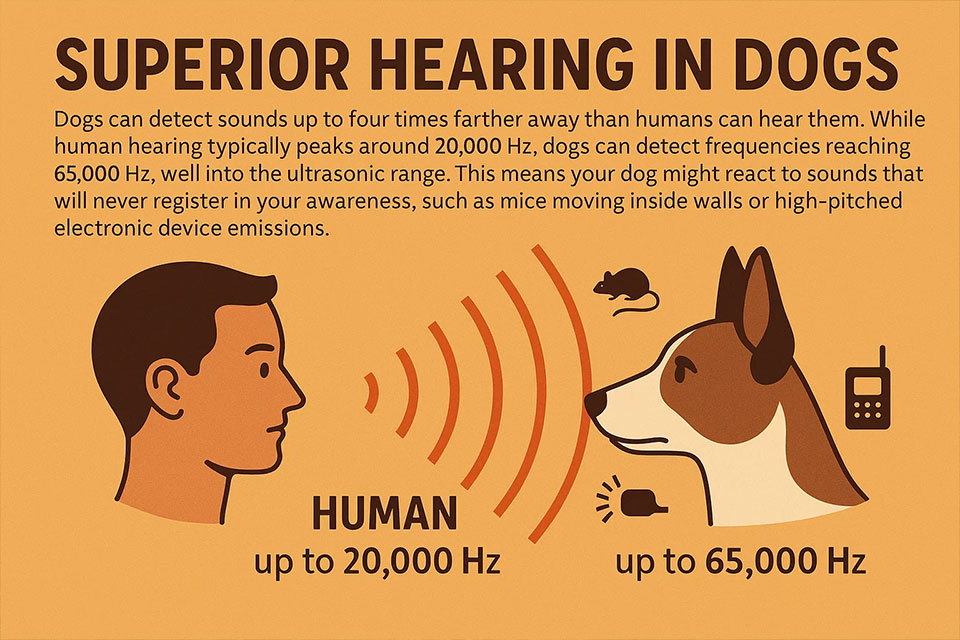
Dogs can detect sounds up to four times farther away than humans can hear them. While human hearing typically peaks around 20,000 Hz, dogs can detect frequencies reaching 65,000 Hz, well into the ultrasonic range. This means your dog might react to sounds that will never register in your awareness, such as mice moving inside walls or high-pitched electronic device emissions.
Your dog’s sense of smell operates at levels up to 100,000 times stronger than human scent detection. If something or someone occupies a room, regardless of whether it belongs to this dimension, your dog would likely detect it before you notice anything unusual.
Dogs also possess heightened sensitivity to environmental changes that might escape human attention. They can detect subtle shifts in air pressure, minor temperature fluctuations, electrical currents from malfunctioning wiring, and even emotional energy changes in the people around them.
Additionally, dogs experience superior night vision compared to humans. While they don’t see in full color spectrums (their vision emphasizes blues and yellows rather than reds and greens), their eyes are specifically adapted to detect movement in low-light conditions. When your dog suddenly barks at an empty hallway at 2 a.m., they might be responding to movement in shadows that remains completely invisible to you.
Alternative Explanations for Supernatural Behavior
Several non-paranormal factors can produce behavior that appears distinctly spooky:
Electromagnetic Field Sensitivity: Some researchers suggest that dogs may react to changes in electromagnetic fields, which can also cause humans to experience unease in locations commonly described as haunted.
Environmental Changes: Sudden drafts or lingering scent traces from previous visitors can trigger alert responses in dogs, even when these changes are imperceptible to humans.
Trauma Response Patterns: Rescue dogs may react intensely to specific sounds, locations, or objects that remind them of frightening experiences, even when the connection isn’t obvious to their owners.
Hidden Wildlife Activity: Raccoons, mice, squirrels, and other small animals living within walls or attic spaces can generate sounds and movements that provoke strong reactions from dogs while remaining undetected by humans.
Still, when you find yourself alone at home and your dog suddenly fixes their gaze on the hallway as if something just called their name, scientific explanations don’t always provide emotional comfort.
Sometimes your dog detects an actual spirit. Sometimes they hear a squirrel in the ceiling. Either scenario can create an unsettling atmosphere.
Pet Psychic Perspectives
Not everyone seeks scientific explanations when their dog stares intensely at seemingly empty space. Some people consult pet psychics, which represents a legitimate profession within certain communities.
Pet mediums claim they can establish telepathic communication with animals, accessing information about emotions, past experiences, and sometimes contact from deceased beings. Some practitioners assert that pets function as energetic protectors, maintaining awareness of spiritual disturbances that might affect their households.
Stories emerge of dogs “detecting” deceased relatives in rooms, refusing to enter specific areas, or lying down precisely where a lost loved one used to rest. Animal intuitives like Sonya Fitzpatrick and Amelia Kinkade have built professional practices around communicating with pets, both living and deceased. Their consultations sometimes include statements such as “your dog detects a new presence in the home” or “he’s protecting you from a male spirit who carries the scent of tobacco.”
This raises an intriguing question: if dogs could communicate verbally, would they report seeing “a man in period clothing standing near the refrigerator,” or would they simply request additional treats?
Whether these beliefs resonate with you or not, one fact remains clear: your dog perceives something that captures their attention. The mystery lies in determining whether their response stems from spiritual, scientific, or wildlife-related causes.
When to Seek Professional Help
The likelihood that your dog is witnessing supernatural reenactments in your living space is statistically low. Most instances of dogs staring at corners, growling at apparent emptiness, or suddenly fleeing rooms as if escaping danger represent normal canine behavior patterns.
Their enhanced sensory capabilities often trigger responses to stimuli that remain undetectable to humans, such as faint scent traces, barely audible sounds, or subtle light changes.
However, certain behavioral patterns warrant veterinary consultation:
Contact your veterinarian if you observe unusual behaviors such as bumping into furniture or appearing confused in familiar environments, extreme anxiety or aggression that seems uncharacteristic, new behaviors accompanied by signs of illness or physical discomfort, frequent staring into space with poor responsiveness to your voice, repetitive pacing or whining at the same location night after night, excessive barking without identifiable triggers (especially during sleep), or disorientation and appearing “disconnected” during daytime hours.
If your dog maintains good health and simply shows heightened interest in specific areas of your home, you likely have no cause for concern. You can choose to perform cleansing rituals, offer a brief prayer, or simply dismiss the behavior and return to your regular activities.
Your dog might be protecting you from spiritual entities, or they might simply be fulfilling their role as an intensely vigilant security system.
Senior Dogs and Cognitive Changes
If your older dog has begun barking at blank walls, staring into corners, or pacing during nighttime hours as if being followed by something invisible, the explanation might not involve supernatural elements. These behaviors could indicate canine cognitive dysfunction, commonly known as dog dementia.
As dogs age, their brains undergo changes similar to those seen in human Alzheimer’s disease. They may appear confused in familiar locations, develop increased anxiety, or begin reacting to phenomena that seem absent to human observers. However, an important factor to consider is that senior dogs often experience partial or complete hearing and vision loss.
A creaking floorboard or moving shadow might startle a dog with diminished senses. A person entering a room undetected due to hearing loss might feel threatening or confusing. When combined with cognitive changes, the familiar environment can become a strange and unpredictable place.
Warning signs to monitor include wandering without purpose or becoming stuck in corners, excessive barking (particularly at night or at apparent emptiness), disorientation in familiar spaces, difficulty recognizing family members or other pets, increased anxiety (especially in darkness), bumping into furniture, or ignoring verbal commands.
These symptoms can closely resemble reactions to supernatural presence, but they often result from sensory confusion rather than spiritual encounters.
If you notice these patterns, schedule a veterinary consultation. Medications, dietary supplements, and environmental modifications such as nightlights, background noise, or scent markers can significantly improve your senior dog’s comfort and sense of security.
If your dog appears to be responding to ghostly presence, the explanation might not involve the supernatural. Your companion might simply be experiencing the natural aging process.
If burning sage and whispering reassurances provides you with comfort, there’s no harm in these practices.
Understanding Your Dog’s Awareness
Whether your dog responds to spiritual presence, small animals, or air currents moving through ventilation systems, one certainty remains: your dog isn’t fabricating their reactions. Dogs are naturally equipped to notice details that escape human attention.
Dogs interpret their environment through subtle environmental shifts: the movement of shadows, the rustling of leaves, or scent traces from hours-old activity. When your dog suddenly stops moving, stares into darkness, or growls at hallways, trust that something has captured their attention.
The phenomenon may not involve paranormal activity, but it represents something meaningful within your dog’s experience.
Learning to interpret your dog’s body language helps you understand their emotional state during these moments. Observe whether their tail appears stiff and raised, whether their ears point forward or pull backward, and whether they seem alert, frightened, or simply curious.
These physical signals communicate information more effectively than verbal communication ever could. When your dog leans against you during strange moments, makes gentle eye contact, or brings you their favorite toy afterward, they’re not expressing fear. They’re demonstrating affection.
Your dog’s instincts may create unsettling moments, but their loyalty remains genuine. They don’t merely react to environmental stimuli. They actively monitor your safety and well-being.
The next time your dog freezes during a walk and stares into darkness, consider whether panic is necessary. Or perhaps trust their instincts and simply pick up your pace.
Decoding Canine Communication
Dogs maintain constant communication through tail position, ear placement, posture adjustments, and even blinking patterns. Consider these communication signals: a slow blink from your dog indicates trust (similar to feline behavior), tail wagging toward the right typically suggests happiness while leftward wagging can indicate anxiety, and dogs can detect your mood changes through minute chemical alterations in your scent.
When your dog freezes, stares into dark spaces, or leans against you after barking at apparent emptiness, they’re not simply reacting to their environment. They’re attempting to share information with you.
Understanding what your dog is genuinely trying to communicate requires learning to recognize their body language signals. Whether they’re detecting spiritual presence or experiencing anxiety, your dog is actively communicating. Observing their physical cues can help you identify signs of fear, affection, curiosity, and other emotional states, allowing you to respond appropriately to their needs and concerns.


dddd